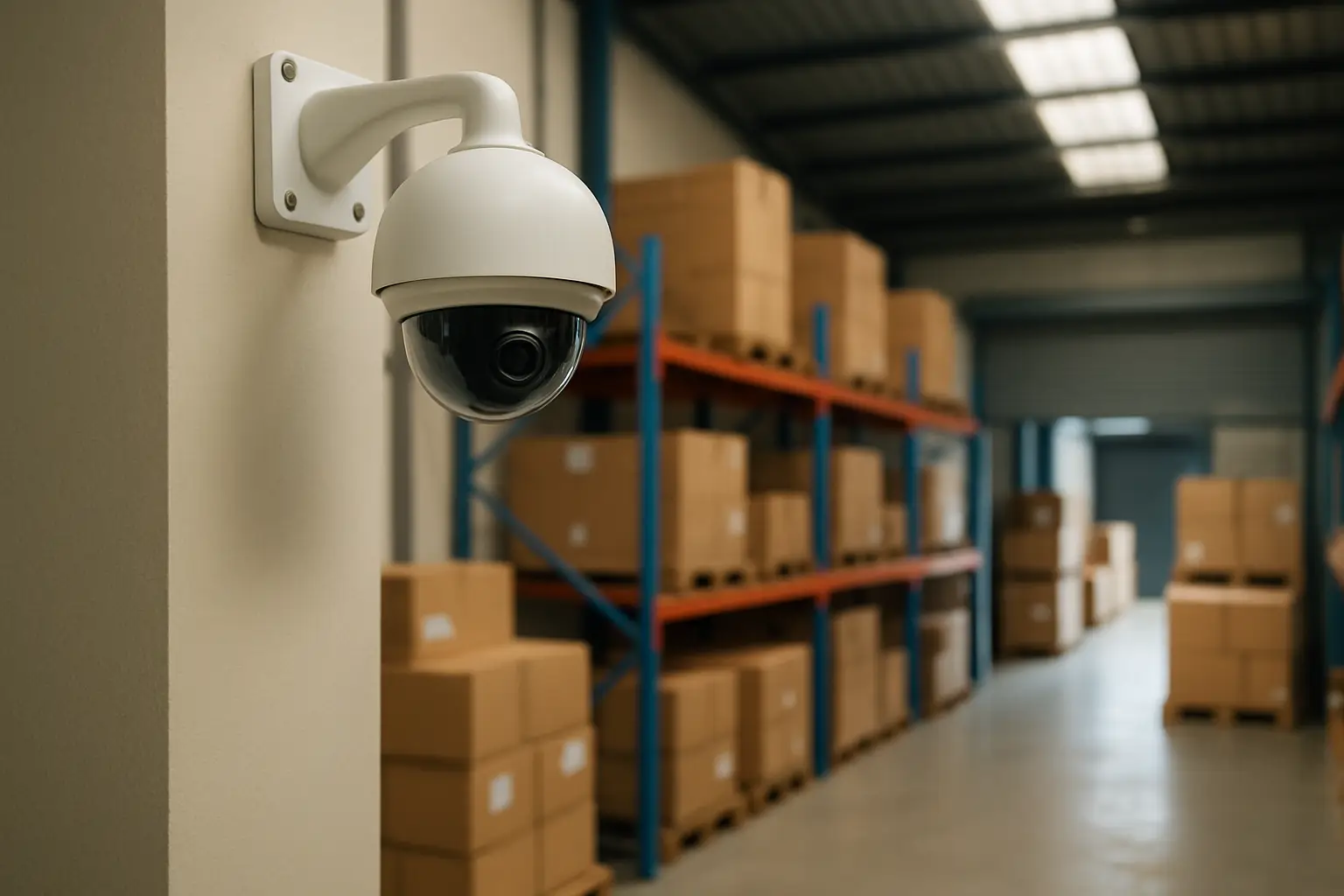
A small warehouse can go from “we’ll notice if something’s off” to “how did that pallet walk out?” in one busy week. The reality is that most losses don’t look dramatic. It’s a side door propped open for a delivery. A return that never makes it back to the shelf. A forklift incident no one can confidently explain. CCTV helps because it replaces guesswork with visibility - but only if it’s planned for the way warehouses actually operate.
This practical guide breaks down what a good CCTV installation for small warehouse environments looks like, where systems commonly fail, and how to make choices that hold up in real day-to-day use.
What “good coverage” means in a small warehouse
Warehouse camera coverage isn’t about putting a camera in each corner and calling it done. You’re trying to answer specific questions after an incident: Who entered? From where? What did they touch? Where did the product go? The best systems are designed around those questions, not around camera count.
In a typical small warehouse, coverage needs tend to fall into three lanes. First is perimeter accountability - doors, gates, and roll-ups. Second is operational visibility inside - aisles, staging, and high-value zones. Third is safety documentation - areas where people and equipment interact. Each lane may need a different camera angle, lens, or mounting height.
It also depends on what you store and how you move it. A warehouse handling high-value electronics has different risk than one storing bulky, low-theft materials. If you run late shifts, low-light performance matters more. If you rely on a shared yard or common hallway, you may need to capture transitions between spaces, not just your own door.
CCTV installation for small warehouse layouts: start with a simple map
Before choosing equipment, sketch a quick map. You don’t need CAD drawings - just something that shows walls, doors, racks, docks, office areas, and any exterior approach.
Then identify your “must-capture” points. In most warehouses, that’s the main entrance, every employee-accessible door, roll-up doors, loading docks, and the path between the dock and storage. If you have a cage, a tool room, or a high-shrink shelf area, that becomes a must-capture zone too.
From there, look for likely blind spots. Rack rows can block views. Tall inventory creates moving walls. If you only cover the end of an aisle, you may miss what happens mid-aisle. In those cases, it’s often better to cover aisle intersections and travel paths rather than trying to read labels deep in a row.
One more map check that gets overlooked: camera placement must match how people actually move. If employees enter through a side door because it’s closer to the parking area, that door is a priority even if it’s not “the main entrance” on paper.
Camera types that make sense in warehouses (and why)
Most small warehouses do well with a mix of turret and bullet cameras. Turrets are great for interior mounting because they’re compact and easier to aim precisely at aisles and work areas. Bullets are common outdoors because they’re visible, often deter behavior, and are easier to mount on exterior walls.
Resolution matters, but only when paired with the right field of view. 4K cameras are excellent when you need facial detail at an entrance or you need to identify what’s happening at a dock from a distance. The trade-off is storage and bandwidth - higher resolution creates larger recordings. In some zones, a slightly wider view at lower resolution can be more useful than a narrow 4K shot that misses the context.
For warehouses with mixed lighting, prioritize cameras with strong low-light performance and good wide dynamic range. This is especially important at dock doors where bright daylight and interior shadows fight each other. Without it, you get silhouettes instead of faces.
The NVR decision: reliability beats “fancy features”
A warehouse system should keep recording even when nobody is watching it. That’s why a reliable NVR setup matters. You want stable recording, clear playback, and enough storage to keep footage long enough to be useful.
Retention depends on your operation. Some businesses only need 7 to 14 days. Others want 30 days because inventory audits, chargebacks, or internal reviews take time. The practical approach is to decide how far back you’ve needed to look in the past, then build storage around that.
Motion recording can save space, but warehouses are full of motion - fans, forklifts, shifting light, and people. Many small warehouses choose continuous recording on key cameras (doors, docks, high-value areas) and motion-based recording on lower-priority angles. It’s a balanced approach that avoids missing the one moment that mattered.
Placement priorities: where cameras actually earn their keep
Exterior doors, roll-ups, and dock areas
Every exterior entry should capture faces and the direction of travel. That usually means mounting at a height that avoids easy tampering but still gives a usable angle. If a camera is too high and pointed down steeply, you get the top of a hat instead of a face.
Loading docks deserve special attention. They’re busy, they involve third parties, and they’re where inventory changes hands. A good dock view shows the dock door, the staging area just inside, and the approach path where pallets move.
Interior aisles and intersections
Aisles can be tricky. One camera aimed down a long aisle often looks good until racks fill in, or a forklift blocks the shot. Intersections - where aisles meet and traffic turns - usually provide better documentation of movement. If you can see who entered an aisle and who exited with product, you often don’t need a camera halfway down every row.
High-value storage and cages
If you have controlled inventory, cages, or small items that walk off easily, treat that area like a “room within a room.” Use tighter views, make sure you can see hands and access points, and avoid wide shots that only prove someone was nearby.
Office and receiving counters
Small warehouses often have a front office that doubles as receiving, dispatch, or customer pickup. Cameras here help with disputes, cash handling, and after-hours access. They also provide context when a key goes missing or an alarm is triggered.
Wiring, mounting, and the difference between clean and costly
Good installations are boring in the best way. Cables are protected, labeling is clear, the NVR is in a secure spot, and nothing is dangling near forklifts.
For most warehouses, PoE (Power over Ethernet) is the simplest and most reliable approach because one cable handles power and data. The main trade-off is that you need proper cable runs. If the warehouse has open rafters, cable can be neatly supported and routed. If it has finished ceilings in office areas, those transitions need to be planned so you don’t end up with exposed cable where it looks unprofessional or becomes an easy grab point.
Outdoor runs need weather protection, and any exposed sections should be shielded from sun and physical impact. Inside, avoid placing cameras where dust buildup, vibration, or direct forklift traffic will shorten their life.
Remote access that’s secure and actually usable
Most owners want to check cameras from their phone. That’s reasonable - but the setup needs to be secure, stable, and simple enough that it still works when you change phones or add a manager.
A practical remote access setup includes strong passwords, controlled user permissions, and a clear plan for who gets admin access. It also depends on your internet connection. If your upload speed is limited, you may see lower-quality live views offsite. That doesn’t necessarily mean your recordings are low quality - it often means the system is sending a lighter stream to your phone while saving full quality locally.
Common mistakes we see in small warehouses
One mistake is buying “more cameras” instead of fixing angles. Eight cameras that miss faces won’t outperform four cameras placed correctly.
Another is ignoring lighting. A camera pointed at a bright roll-up door can look great at noon and become useless at dusk if the settings and camera choice weren’t designed for it.
A third is placing the NVR in an easy-to-reach spot. If someone can walk off with your recorder, you lose the footage when you need it most. Lock it up, or place it in a secured office or network closet.
Finally, many warehouses don’t test playback until something happens. You want to know now if your timestamps are correct, if your recordings are continuous, and if you can export footage without a headache.
What a straightforward install process looks like
A solid process starts with a site walk, your coverage goals, and a layout-based plan. Then it moves into cable routing, mounting, NVR setup, and camera aiming with real-world verification - meaning someone walks through doors, moves through aisles, and checks the actual recorded image, not just the live preview.
After installation, the handoff matters. You should know how to search by time, back up clips, and adjust user access. Ongoing support is part of what makes CCTV a tool instead of a one-time project that slowly becomes outdated.
If you’re in the Sacramento area and want a system designed around your specific layout and workflow, StaySafe365 can help with professional camera installation and support at https://staysafe365.net.
Budgeting without guessing
Small warehouses often want a number right away, but pricing depends on the building and the level of coverage. The two biggest drivers are cable complexity and the number of priority areas that need higher-detail views.
If you’re trying to keep costs controlled, start by protecting the perimeter and the dock, then add interior coverage where losses or incidents are most likely. That approach usually delivers better results than spreading cameras thin across every corner.
The best budget question isn’t “what’s the cheapest system?” It’s “what’s the least I can install while still getting usable footage when something happens?” That’s the line worth finding.
A well-planned CCTV system doesn’t just record problems - it reduces them, because expectations are clear and visibility is consistent. When your cameras are placed for the way your warehouse really runs, you spend less time chasing missing details and more time running the operation with confidence.