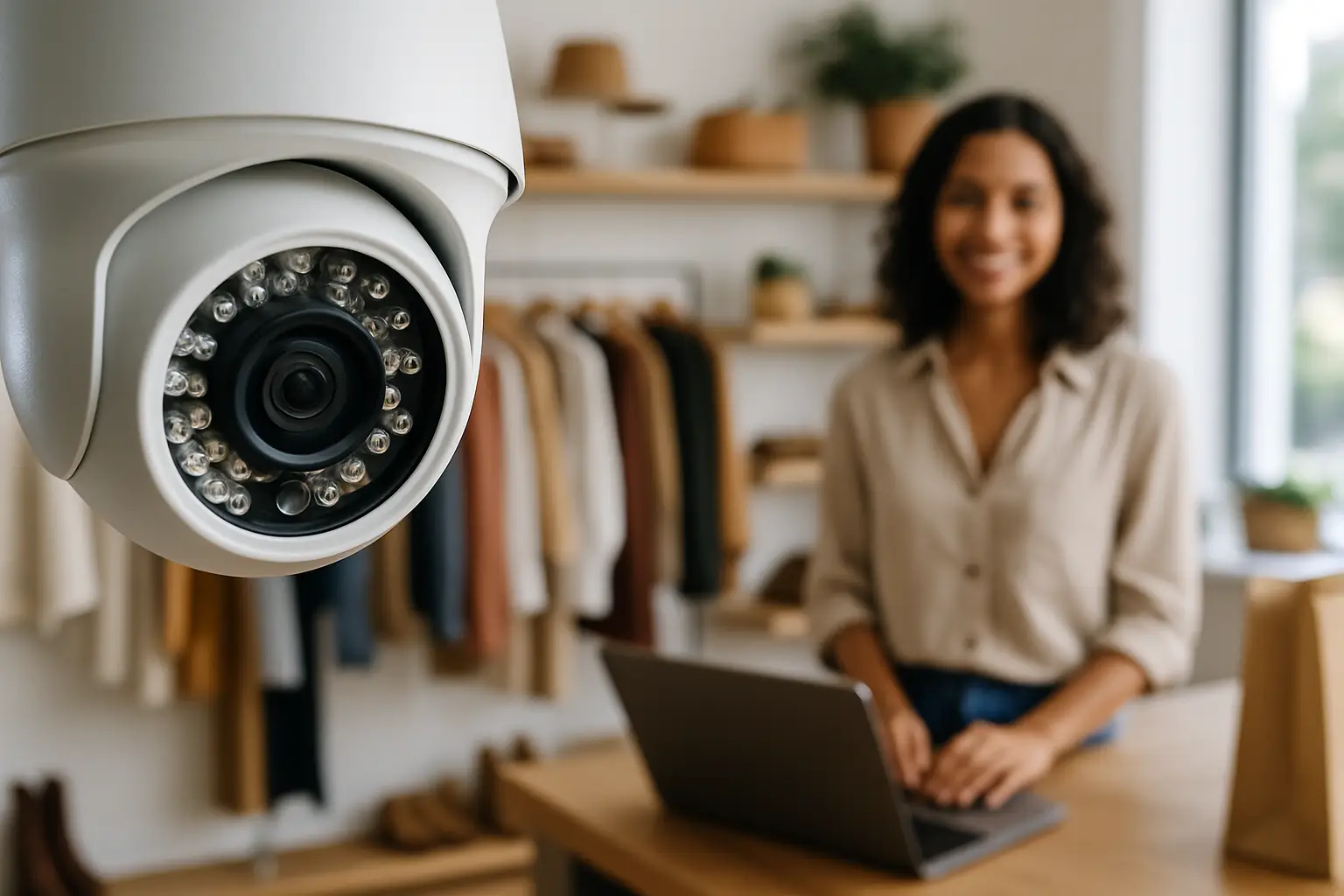
The fastest way to waste money on retail security is buying cameras before you’ve walked your floor like a customer and like a thief. Stand at the front door, then the back aisle, then behind the counter. Notice what you can’t see from each spot. That is where your cameras need to do the work.
For most shops in Sacramento - convenience stores, salons, boutiques, smoke shops, liquor, small groceries - “best” usually means clear identification at the door, clean coverage of the register, and reliable recording when nobody is watching the screen. The right camera is the one that fits your lighting, your ceiling height, and your daily operations.
What “best cameras for small retail” actually means
When people search for the best cameras for small retail, they’re often thinking about brand names. In practice, your results depend more on camera type, lens choice, placement, and recording settings than the logo on the box.
A good small retail camera setup does three things consistently. First, it captures usable faces at the entrance, not just “a person-shaped blur.” Second, it records transactions and counter interactions clearly enough to settle disputes. Third, it keeps working through real life - glare from front windows, low light at closing time, and the occasional bumped camera.
Start with the risks and the layout, not the camera list
Most small retail losses happen in predictable places. Front door traffic, the register area, and blind spots created by tall shelving are the usual culprits. Your layout tells you what camera style to prioritize.
If your store has a big glass frontage, you’ll fight backlighting during the day. If you have narrow aisles, you’ll want a lens that reaches without turning faces into pixels. If you’re open late, color night vision or strong infrared matters more than fancy features.
A simple planning step: mark your “must ID” zones (faces and hands matter) versus “must see” zones (movement and general coverage). Entrances and registers are “must ID.” Stock rooms, back hallways, and wide floor coverage are usually “must see.”
The 7 best camera types for small retail (and when to use each)
You can build an excellent system with a mix of camera types. Most small stores do not need every camera to be the same. In fact, mixing types is often what turns an average system into a useful one.
1) 4K turret (eyeball) cameras for most indoor coverage
If you want one dependable, all-around camera style for indoor retail, it’s a 4K turret camera. Turrets handle indoor lighting well, resist glare better than many domes, and are easier to aim precisely at a doorway or aisle.
They’re ideal for sales floors, behind the counter, and the back room. The trade-off is they’re more visibly “a camera,” which some owners like for deterrence and others don’t.
2) Varifocal cameras when distance and detail both matter
A fixed lens is fine until you realize your entrance is 25 feet from your mounting spot, or your register camera needs to read bills and see faces in one view. Varifocal cameras let you dial in the field of view so the image isn’t too wide (faces too small) or too tight (you miss context).
They cost more than fixed-lens models, but in small retail they often replace two “almost right” cameras with one “actually useful” camera.
3) Doorway-focused cameras for clean face capture
Entrances are where many systems fail. The camera is too high, pointed too wide, or aimed into sunlight. A dedicated entrance camera - positioned to capture faces as people walk in - is one of the highest-value choices you can make.
You’re not trying to cover the whole store from the door. You’re trying to get a straight-on, well-lit face shot. The trade-off is that this camera may feel redundant if you already have a wide overview, but it’s the difference between “we saw them” and “we can identify them.”
4) Dome cameras where tamper resistance is the priority
Domes make sense in areas where customers can reach the camera or where you expect someone might try to twist it. They’re common in low-ceiling shops, small lobbies, and tight entryways.
The downside is domes can suffer from reflections, and if the dome cover gets dirty or scratched, your image quality drops. For a clean install, they work best when you can keep them out of direct glare and maintain them.
5) Outdoor-rated bullets for parking and storefront exteriors
If you need coverage outside - front sidewalk, parking spots, rear delivery area - bullet cameras are often the practical pick. They’re easy to aim, they typically have strong night vision, and they’re built to handle weather.
Bullets are more noticeable, which helps deterrence. The trade-off is aesthetics and placement - you want them high enough to reduce tampering while still close enough to capture usable detail.
6) Low-light or color night vision cameras for late hours
If you’re open late or your store lighting is dimmed at closing, low-light performance matters more than extra megapixels. Some cameras rely heavily on infrared, which gives you black-and-white footage at night. Others can stay in color with minimal lighting.
Color at night can be a game-changer for describing clothing and vehicles, but it may require some ambient light. If your exterior is pitch-dark, infrared may be the more reliable option.
7) Dedicated LPR-style coverage for vehicle plates (special case)
License plate capture is not a standard “throw a camera up” feature. It’s a specific use case that requires the right angle, distance, and settings. If your business has repeat issues like after-hours vandalism or parking lot incidents, a dedicated plate-focused view can help.
The trade-off is that an LPR-style view is narrow and purpose-built. It doesn’t replace your general parking lot camera. It complements it.
Key features that matter in a small retail system
If you only compare specs, everything looks similar. The features below are the ones that change your day-to-day results.
4K resolution (with realistic expectations)
4K is worth it for small retail when you’re trying to identify faces, read actions at the counter, or zoom in after the fact. But resolution is not magic. If a camera is too far away or pointed too wide, 4K footage still won’t identify someone.
WDR for glass storefronts
Wide Dynamic Range (WDR) helps when your camera faces bright windows or strong sunlight. Without it, the person becomes a silhouette. With it, you have a better chance at a usable face.
Smart motion alerts that don’t drive you crazy
Motion alerts are only helpful when they’re specific. Look for human and vehicle detection so your phone isn’t buzzing every time lights change or a ceiling fan spins. Even then, alerts should be tuned. A good system reduces noise, not your patience.
PoE wiring and NVR recording for reliability
For small retail, Power over Ethernet (PoE) cameras with a Network Video Recorder (NVR) are usually the most stable option. You avoid Wi-Fi dropouts, you get consistent recording, and you can expand without reinventing the system.
Wi-Fi cameras can work for a single view or a temporary need, but they’re more sensitive to network congestion and power interruptions. If your goal is evidence you can rely on, wired PoE is the safer bet.
Storage that matches your risk
Many owners want “a month of footage” without realizing storage depends on camera count, resolution, frame rate, and how often motion triggers recording. If you record 24/7 in 4K on multiple cameras, you’ll need more hard drive space than most starter kits include.
A practical target for many small stores is 14 to 30 days, depending on how quickly you discover incidents. The right answer depends on your operations, not a generic rule.
A simple way to size a camera plan for a small shop
Most small retail spaces end up needing coverage in four zones: entrance, register, sales floor, and back-of-house. A common approach is one dedicated camera for the door, one or two for the counter (depending on angles), two to four for aisles and open floor, and one for the stock room or back door.
If your shop has high shelves, you may need more cameras, not higher resolution. Tall shelving creates blind spots that no single wide-angle camera can solve.
Common mistakes we see in small retail camera installs
The most common problem is mounting cameras too high and too wide. It feels safer, but it usually produces footage where faces are small and angles are steep.
Another issue is ignoring lighting. A camera aimed directly at a bright window is going to struggle unless it’s chosen and positioned for that environment. The last common mistake is underestimating recording needs. Owners discover an incident two weeks later and find the footage is already overwritten.
If you want a system that’s designed around your exact layout and sightlines, that’s the kind of planning and clean installation we do at StaySafe365 for Sacramento-area shops - along with making sure you’re comfortable using remote viewing and playback when it matters.
Choosing what’s “best” for your store
The best cameras for small retail are the ones that produce clear identification where it counts, record reliably without babysitting, and fit the way your store actually runs. If you’re unsure, don’t start by asking “Which brand is best?” Start by asking “Where do I need to identify someone, and what lighting and distance am I dealing with?”
A helpful next step is to take five minutes after closing, walk your store, and note every place you’d want footage if something happened tomorrow. That list will tell you more about the right cameras than any spec sheet ever will.